
3D XPoint Market Share, Growth & Forecast by 2034
Coverage: By Storage Type (750 GB, 1.5 TB, Others); End User (Telecommunication, Consumer electronics, Automotive, Healthcare, Retail, Others) , and Geography (North America, Europe, Asia Pacific, and South and Central America)
- Status : Data Released
- Report Code : TIPRE00017715
- Category : Electronics and Semiconductor
- No. of Pages : 150
- Available Report Formats :


- Last update date : July 15, 2026


2025 Market Size
US$ 1.91 Bn
Base year value
2034 Forecast
US$ 19.56 Bn
Projected by 2034
CAGR 2026-2034
29.53 %
Growth rate
Addressable Market
US$ 77.62 Bn
(2026-2034)
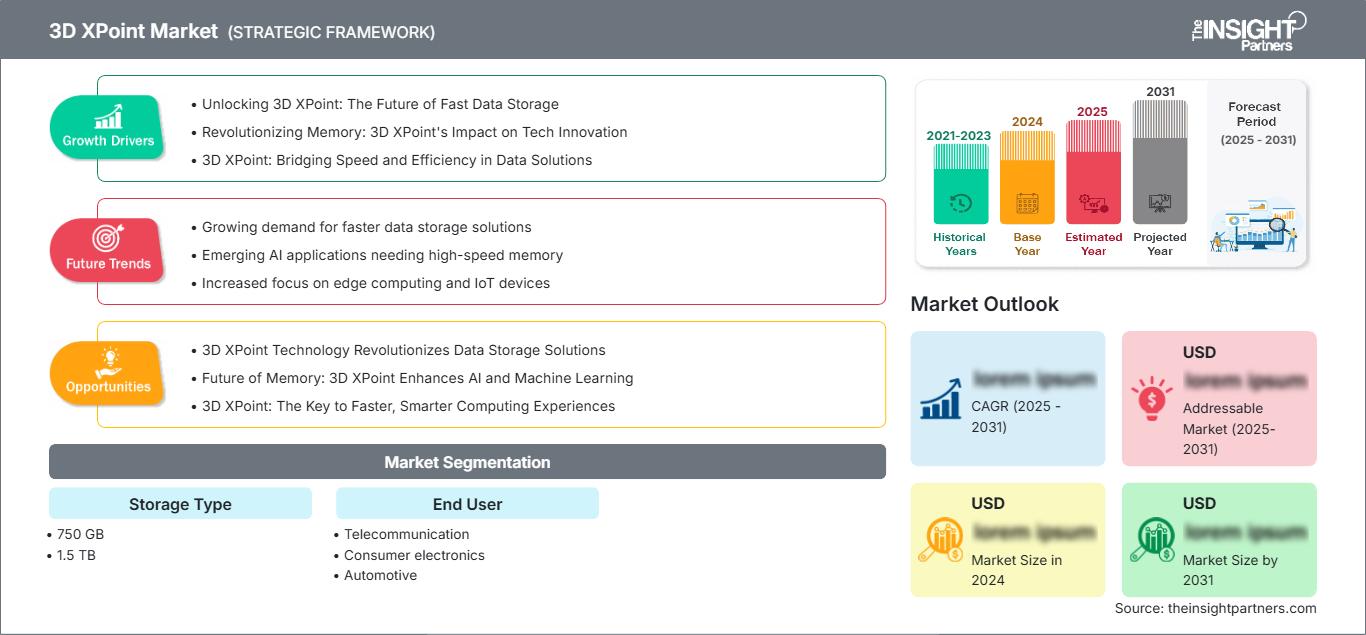
The 3D Xpoint Market size is expected to grow from US$ 1.91 billion in 2025 to US$ 19.56 billion by 2034; it is anticipated to register a CAGR of 29.53% during 2026–2034. Demand is being shaped by persistent-memory use cases, latency-sensitive enterprise workloads, and storage-class memory adoption across telecommunications, consumer electronics, automotive, healthcare, and retail environments.
North America is projected to remain a strategic demand center, expanding at a CAGR range of 27–30% as hyperscale computing, AI inference, and enterprise storage modernization increase the need for lower-latency memory tiers. The region benefits from mature cloud infrastructure, strong semiconductor design ecosystems, and early adoption of persistent memory in data-intensive industries.
3D XPoint Market Assessment and Insights
- North America: The region held a 36–38% share in 2025 and is growing at a CAGR of 27–30% during 2026–2034, supported by hyperscale data centers and enterprise AI storage refresh cycles.
- US: The US represented 78–82% of North America in 2025 and is expanding at a CAGR of 27–30%, led by cloud infrastructure, semiconductor R&D, and data-intensive healthcare analytics.
- Europe: Europe accounted for 21–23% share in 2025 and is growing at a CAGR of 25–28%, with Germany, the UK, and France leading adoption in automotive, telecom, and industrial computing.
- Asia Pacific: Asia Pacific held 31–33% share in 2025 and is growing at a CAGR of 31–34%, driven by China, Japan, South Korea, and India through electronics manufacturing and 5G infrastructure.
- Largest Segment: Telecommunication held 30–34% market share in 2025 and is growing at a CAGR of 28–31%, supported by edge servers, routing infrastructure, and low-latency network caching.
- High Growth Segment: Healthcare held 12–15% market share in 2025 and is growing at a CAGR of 32–35%, supported by imaging analytics, genomics, and rapid clinical data access.
- Key companies analyzed in detail: Intel Corporation, Micron Technology, Inc., Samsung Electronics Co., Ltd., SK hynix Inc., Sony Group Corporation, Kioxia Corporation, Western Digital Corporation, Mushkin Enhanced MFG, Numonyx B.V., and Texas Instruments Incorporated.
Source: The Insight Partners' analysis based on proprietary research, government publications, company annual reports, investor presentations, industry databases, and expert interviews.
Technology evolution in the 3D Xpoint Market report is moving from legacy Optane-style products toward broader storage-class memory architectures that bridge NAND and DRAM performance. Although earlier commercialization faced cost and ecosystem constraints, demand for real-time analytics, edge AI, and high-endurance write workloads has kept the 3D Xpoint scope relevant. Production dynamics are increasingly shaped by advanced packaging, controller optimization, and selective deployment in systems where latency savings justify premium memory economics.
Forward momentum is expected to come from geographies investing in sovereign semiconductor capacity, AI-ready data centers, and resilient digital infrastructure. Policy support for chip manufacturing in the US, Europe, Japan, South Korea, and India strengthens long-term supply options, while data localization rules encourage localized high-performance storage. These shifts are likely to widen 3D Xpoint market analysis beyond enterprise servers into automotive, healthcare, and telecom edge environments.
3D XPoint Market Report Scope
| Report Attribute | Details |
|---|---|
| Market size in 2025 | US$ 1.91 Billion |
| Market Size by 2034 | US$ 19.56 Billion |
| Global CAGR (2026 - 2034) | 29.53% |
| Historical Data | 2021-2024 |
| Forecast period | 2026-2034 |
3D XPoint Market Analysis
Demand in the market is concentrated in workloads where conventional NAND latency limits service quality, including telecom packet processing, AI feature stores, electronic health records, and high-frequency retail transaction systems. The value chain spans material science, wafer processing, controller firmware, module integration, server OEM qualification, and workload tuning, making ecosystem readiness as important as raw device performance.
Supply dynamics remain specialized because 3D Xpoint requires differentiated process know-how, reliable selector materials, and controller support that can exploit byte-addressable persistence. Enterprises evaluating the 3D Xpoint size increasingly compare total latency reduction, endurance, and power efficiency against high-end NVMe SSDs and emerging CXL memory pools rather than against commodity storage alone.
Competition dynamics are dictated by memory incumbents and storage experts. Intel Corporation and Micron Technology, Inc. built an initial reputation for technical excellence, but Samsung Electronics Co., Ltd., SK hynix Inc., Kioxia Corporation, Western Digital Corporation, and Sony Group Corporation now dominate the NAND, controller, and enterprise storage segments. Mushkin Enhanced MFG focuses on enthusiast and specialized SSD markets.
The movement of capital appears to be towards enhancing the memory hierarchy system rather than replacing individual components. The purchase of the former Lehi plant by Texas Instruments Incorporated and increased investment in AI capabilities, along with additional advanced packaging, suggest that the 3D Xpoint market share opportunity rests on system-level implementation. Organizations will gain an advantage through endurance, low latency, and compatibility positioning strategies.
● REPORT CUSTOMIZATION
Tailor This Report To Align With Your Specific Business Requirements
This report can be customized to align precisely with your business objectives, scope, and target markets. Customization options include tailored segmentation, geography, competitive analysis, and strategic insights to support informed decision-making.
Customize This Report →WHAT YOU CAN ADJUST
- ● Segmentations
- ● Geography
- ● Competitive Analysis
- ● Language Preferences
3D XPoint Market: Strategic Insights
Regional Insights
North America 3D Xpoint Market
North America accounted for 36–38% share in 2025 and is expected to grow at a CAGR of 27–30% through 2034. Cloud operators, defense computing, financial services, and healthcare analytics drive demand for persistent memory tiers that reduce application latency and improve write endurance in high-availability environments.
Regional-level adoption could be supported by mature server OEM networks, investments in AI, and semiconductor policies aimed at boosting chip capacity in the region. In North America, for instance, adoption of 3D XPoint is selective, and users prefer use cases with low latency, fast boot, and endurance.
U.S. 3D Xpoint Market
In 2025, the US had a market share of 78% to 82% of North America and is estimated to grow at a CAGR of 27% to 30% from 2026 to 2034. The need for predictable latency performance for massive datasets in hyperscale computing, AI model serving, electronic trading, and medical image processing is driving demand for SSDs.
Company presence will play an important role in the domestic ecosystem. Intel Corporation, Micron Technology, Inc., Western Digital Corporation, Texas Instruments Incorporated, and Mushkin Enhanced MFG have helped in design, legacy product experience, storage systems, manufacturing facilities, or specialized SSD distribution channels. Application trends favor enterprise caching, persistent databases, and low-latency edge analytics.
Europe 3D Xpoint Market
Europe held 21–23% share in 2025 and is forecast to grow at a CAGR of 25–28%. Germany is the leading country because automotive electronics, industrial automation, and engineering simulation require memory systems that support fast access to operational and design data.
Cloud computing, financial technology, and research computing constitute the UK's contributions. Low-latency data supports fraud analytics, risk modeling, and artificial intelligence inference. On the other hand, digitization in the public sector fuels the need for robust data storage infrastructure.
France, Italy, and Spain encourage adoption through advanced telecommunications, digital healthcare, and smart manufacturing. Growth is well-balanced because the procurement departments weigh benefits, costs, and reliability.
APAC 3D Xpoint Market
APAC accounted for 31–33% share in 2025 and is projected to grow at a CAGR of 31–34%. China leads regional demand through server localization, AI infrastructure, and electronics manufacturing depth.
Memory production, automotive electronics, and high-end consumer electronics are the strengths of Japan and South Korea. Cloud regions and digital infrastructure development are driving the need for storage-class memory in India.
Australia offers support for the adoption of niche technologies in research computing, mining analytics, and edge computing in telecommunications. Policies to incentivize semiconductor capacity and industrial digitalization are making regions relevant in the long term.
Middle East & Africa 3D Xpoint Market
The Middle East & Africa market is expected to grow at a CAGR of 24–27%, with the UAE leading adoption through cloud zones, financial services digitization, and smart-city infrastructure.
Saudi Arabia’s investment in data center infrastructure, AI solutions, and industrial upgrading results in specific demand for fast storage systems. Enterprises working in the energy sector apply fast memory to perform seismic analysis and operations management.
In South Africa and the rest of MEA, the adoption of persistent storage is slow but increasing owing to investments in telecommunication networks, banking, and government applications.
Segmentation Analysis
Storage Type
The storage type segment is expected to grow at a CAGR of 28–31% during 2026–2034. Adoption depends on workload intensity, server configuration, and the ability to justify premium persistent memory through measurable latency and endurance benefits. Buyers compare capacity options against application response requirements and total infrastructure cost.
- 750 GB products are positioned for targeted acceleration, metadata handling, caching, and edge systems where lower capacity can still deliver meaningful response-time improvement.
- 1.5 TB products support larger persistent datasets, enterprise databases, and memory-tiering use cases where capacity and endurance help reduce bottlenecks in mission-critical systems.
End User
The end-user segment is projected to grow at a CAGR of 29–32% during 2026–2034. Adoption is strongest where organizations process high-volume, time-sensitive data and need storage layers that withstand frequent writes. The segment also reflects 3D Xpoint market growth across industries that are modernizing networks, devices, vehicles, clinical workflows, and retail platforms.
- Telecommunication users apply persistent memory to edge nodes, packet routing, network caching, and 5G service platforms where predictable latency supports service reliability.
- Consumer electronics demand remains selective, centered on premium workstations, gaming systems, and professional devices where fast application loading and endurance justify higher component costs.
- Automotive adoption is tied to autonomous driving logs, infotainment, advanced driver assistance systems, and in-vehicle analytics that require rapid access to sensor-heavy datasets.
- Healthcare users prioritize imaging, genomics, patient data platforms, and AI-assisted diagnostics, where faster data retrieval can improve workflow throughput and clinical decision support.
- Retail deployment focuses on real-time inventory, fraud detection, personalization engines, and point-of-sale analytics that require dependable write endurance during transaction peaks.
Opportunity Snapshot
| Segment Name | Revenue Contribution | Trend Tag | Adoption Stage |
| Telecommunication | High | Edge Caching | Scaling |
| Consumer electronics | Medium | Premium Devices | Emerging |
| Automotive | Medium | Sensor Logs | Scaling |
| Healthcare | Medium | Imaging AI | Scaling |
| Retail | Low | Fraud Analytics | Emerging |
3D XPoint Market Growth Drivers and Impact Analysis
Rising Latency Pressure in AI and Real-Time Analytics
AI inference, recommendation systems, fraud detection, and telecommunications service assurance are driving new demand for storage solutions, as data must be moved swiftly between the compute and persistent tiers. Traditional NAND is still solid in capacity, but latency variability may interfere with timely processing. The market gains from a more measured enterprise approach that estimates the value of quicker recovery, lower tail latencies, and high write endurance. Essentially, a financial institution, a healthcare network, or a telecommunications provider can use persistent memory for applications in which milliseconds matter. This creates a focused but high-value demand base.
Expansion of Edge Computing and 5G Infrastructure
Networks of the 5G era, private wireless infrastructure, and distributed clouds will move computation closer to end users and devices. Edge computing requires small-scale, robust, and fast storage that enables caching, packet inspection, video analysis, and other industrial telemetry tasks without continuous reliance on centralized data centers. This is good news for the 3D Xpoint market, as persistent memory will help reduce latency in edge computing, where frequent reading and writing occur. Telecommunications companies and network operators will adopt this technology in part for dense urban cells, industrial plants, seaports, hospitals, and transportation hubs where service continuity and low latency justify a premium memory investment.
Need for Endurance in Write-Intensive Enterprise Workloads
Many enterprise systems can also generate ongoing writing loads from log files, stream analysis, transactions, and sensor outputs. Conventional SSDs can perform such functions; however, endurance management, caching solutions, and over-provisioning are required, making the process more expensive and complicated. 3D Xpoint market demand increases when there is a need for persistent storage that can handle heavy write loads and deliver predictable performance. Here we can see healthcare imaging databases, automotive fleet testing, or retail fraud detection systems.
3D XPoint Market Future Trends
Memory Tiering Around CXL and Composable Infrastructure
Future deployments are likely to position persistent memory within broader composable infrastructure rather than as isolated storage. Compute Express Link architectures enable memory resources to be pooled, shared, and dynamically allocated across servers. In this environment, 3D Xpoint Market suppliers can target workloads that need persistence, lower latency, and better endurance than NAND-based tiers. The trend will encourage collaboration among memory vendors, server OEMs, cloud operators, and software providers. Successful adoption will depend on management tools that enable enterprises to classify data by latency needs, persistence value, and cost tolerance across hybrid memory pools.
Workload-Specific Persistent Memory Modules
The next stage for 3D XPoint market trends is likely to focus on specialty modules targeting particular use cases rather than a wide-ranging replacement of the consumer memory market. Healthcare imaging, edge caching in telecommunications, automotive simulations, and AI feature stores each have distinct needs for endurance, capacity, thermal management, and firmware tuning. Manufacturers offering persistent memory in combination with a custom controller and other management tools will decrease the risks of adoption for their enterprise customers. The trend enables better value by allowing the customer to buy the outcome of a system, such as speedier recovery or reduced latency variability.
3D XPoint Market Opportunities
Targeted Deployment in Healthcare Data Platforms
The healthcare industry offers an excellent opportunity because imaging, genomics, electronic medical records, and AI-enabled triage produce large datasets that must be processed quickly and made accessible. Healthcare organizations and technology companies can introduce persistent memory into their imaging pipeline solutions, clinical data lakes, and research clusters, where increased speed is critical for greater efficiency. The 3D Xpoint Market opportunity extends beyond hospitals and applies to life sciences research, drug discovery, and public health analytics. To help buyers evaluate potential benefits, suppliers need to emphasize compliance-based architectural design, integration with healthcare storage software, and service models that help buyers measure performance gains without disrupting patient-facing systems.
Partnerships with Telecom Edge Infrastructure Providers
Telecommunications remains the most strategically relevant end-user opportunity because 5G, private networks, and edge services require rapid data access near subscribers and machines. Memory vendors can partner with network equipment providers, cloud edge platforms, and system integrators to validate persistent memory for routing, caching, video analytics, and network observability. The 3D Xpoint Market forecast can gain traction when offerings are embedded into turnkey edge servers rather than sold as standalone components. Investment should focus on thermal design, remote monitoring, and workload certification to reduce deployment complexity for operators managing distributed infrastructure.
Recent Developments
- February 2025: Numemory — introduced the NM101 storage-class memory device, a phase-change and crossbar-based product positioned as an Optane successor for domestic Chinese servers, with reported production targets and patent holdings supporting renewed interest in persistent memory architectures.
- January 2026: Intel Corporation’s discontinued Optane and 3D XPoint storage portfolio continued to be discussed across the technology press as a reference point for persistent memory, with analysis highlighting its low-latency performance, endurance advantages, and commercial challenges after the Optane wind-down.
- July 2024: Independent technology analysis revisited Intel Optane 3D XPoint memory, noting its byte-addressable behavior, strong endurance, low latency, and market limitations following Intel’s earlier end-of-life announcements. The review underscored continued enthusiast and enterprise interest in remaining Optane SSD availability.
Frequently Asked Questions

- Comprehensive Market Sizing and Forecast Analysis
- Detailed Segmentation Analysis
- In-Depth Market Dynamics Assessment
- Regional and Country-Level Insights
- Competitive Landscape and Company Benchmarking
- Strategic Business Intelligence
Recent Reports
Testimonials

The Insight Partners' SCADA System Market report is comprehensive, with valuable insights on current trends and future forecasts. The team was highly professional, responsive, and supportive throughout. We are very satisfied and highly recommend their services.
RAN KEDEM Partner, Reali Technologies LTDs
I requested a report on a very specific software market and the team produced the report in a few days. The information was very relevant and well presented. I then requested some changes and additions to the report. The team was again very responsive and I got the final report in less than a week.
JEAN-HERVE JENN Chairman, Future Analytica
We worked with The Insight Partners for an important market study and forecast. They gave us clear insights into opportunities and risks, which helped shape our plans. Their research was easy to use and based on solid data. It helped us make smart, confident decisions. We highly recommend them.
PIYUSH NAGPAL Sr. Vice President, High Beam Global
The Insight Partners delivered insightful, well-structured market research with strong domain expertise. Their team was professional and responsive throughout. The user-friendly website made accessing industry reports seamless. We highly recommend them for reliable, high-quality research services
YUKIHIKO ADACHI CEO, Deep Blue, LLC.
This is the first time I have purchased a market report from The Insight Partners.While I was unsure at first, I visited their web site and felt more comfortable to take the risk and purchase a market report.I am completely satisfied with the quality of the report and customer service. I had several questions and comments with the initial report, but after a couple of dialogs over email with their analyst I believe I have a report that I can use as input to our strategic planning process.Thank you so much for taking the extra time and making this a positive experience.I will definitely recommend your service to others and you will be my first call when we need further market data.
JOHN SUZUKI President and Chief Executive Officer, Board Director, BK Technologies
I wish to appreciate your support and the professionalism you displayed in the course of attending to my request for information regarding to infectious disease IVD market in Nigeria. I appreciate your patience, your guidance, and the fact that you were willing to offer a discount, which eventually made it possible for us to close a deal. I look forward to engaging The Insight Partners in the future, all thanks to the impression you have created in me as a result of this first encounter.
DR CHIJIOKE ONYIA MANAGING DIRECTOR, PineCrest Healthcare Ltd.Reason to Buy
- Informed Decision-Making
- Understanding Market Dynamics
- Competitive Analysis
- Identifying Emerging Markets
- Customer Insights
- Market Forecasts
- Risk Mitigation
- Boosting Operational Efficiency
- Strategic Planning
- Investment Justification
- Tracking Industry Innovations
- Aligning with Regulatory Trends





 Get Free Sample for